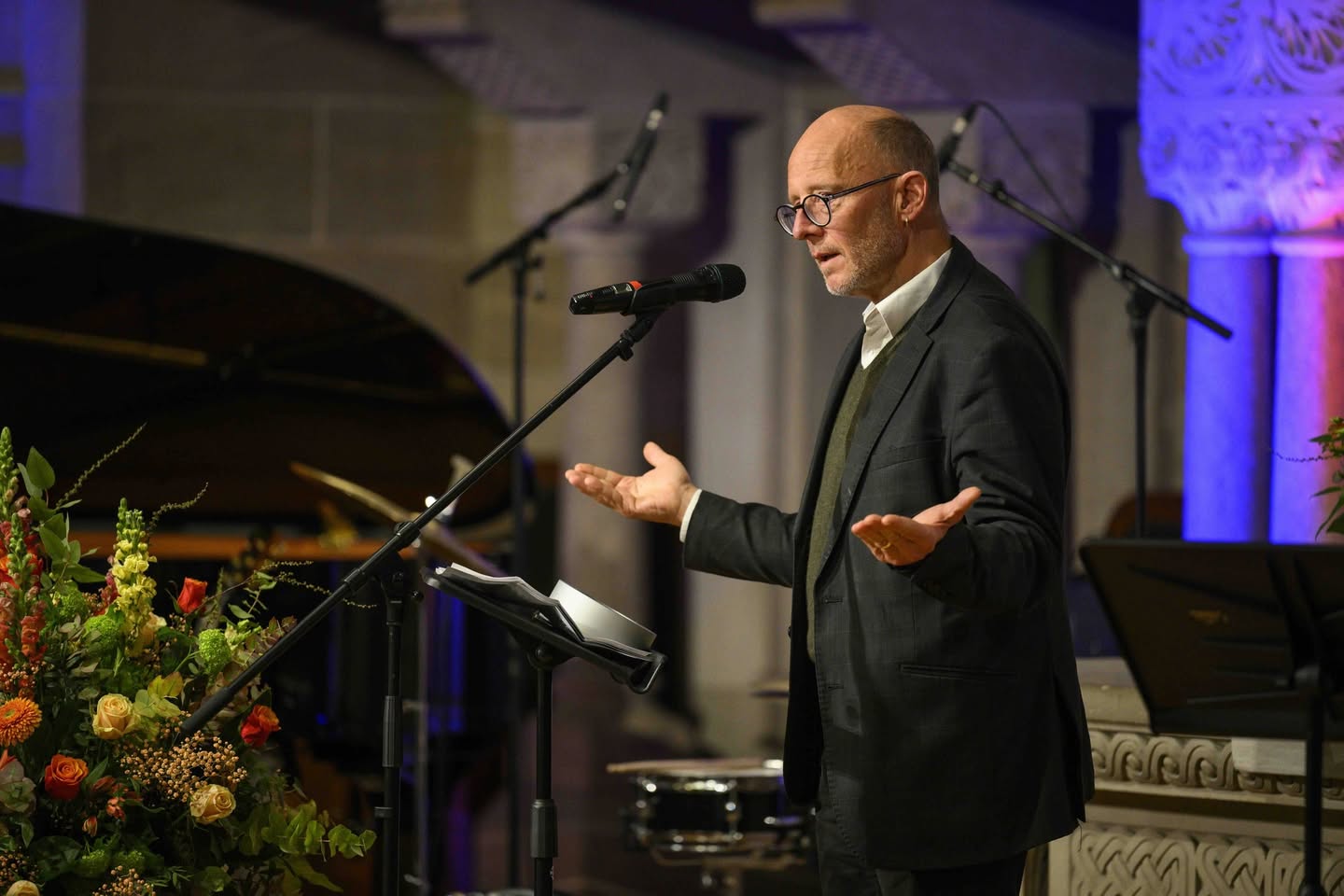
Festrede von Prof. Ralph Kunz
zum 40-jährigen Jubiläum von Crescendo
22 MARCH 2025 BASEL
Liebe Festgemeinde, liebe Künstlerinnen und Künstler
Wir feiern das 40 jährige Jubiläum von «Crescendo» – ein wunderbarer Name für die Arbeit, die einsteht für geistliche Gemeinschaftsbildung und das christliche Zeugnis unter professionellen Musikern. Was Sie für sie, die in Konzerten, in der Schule oder an Kirchen mit ihrer Kunst tun – Gott und Menschen Freude machen – soll lauter werden.
Ich darf heute reden, bin einer der gratuliert und auch ein wenig reflektiert über Crescendo. Mehr ein Glissando – die Töne verbindend, die aufsteigen zum Oberton des Himmels mit den Tönen, die vom Himmel kommen.
Mir ist Jakobs Traum in den Sinn gekommen. Er träumte von einer Tonleiter, auf der Engel rauf und runterrutschten. Von Engeln will ich reden. Aus einem einfachen Grund. Auch sie musizieren; sie haben Erfahrung mit geistlicher Gemeinschaft und sie machen Gott und den Menschen Freude.
In der Bibel werden Engel sichtbar und hörbar, wenn sie eine himmlische Botschaft an Menschen richten. Sie sind per Definition Botschafter (ἄγγελος) Gottes. Worin ihre Aufgabe besteht, besingt Luthers Weihnachtslied: «Vom Himmel hoch da komm ich her, ich bring Euch eine gute neue Mär.»
Aber eben Engel sind nicht nur Boten: Sie singen und beten. Engel sind Beter und Künstler. Darin ähneln sie einer bestimmten Sorte Menschen, vom denen heute überdurchschnittlich viel versammelt sind. Ganz sicher sind auch Engel hier. Ich meine, ich hätte einen gesehen. Er lässt uns Grüsse ausrichten von der unsichtbaren Welt.
Sie wissen: Nicht jeder, der singt, macht Kunst und nicht jede, die Kunst macht, betet. Also ist der Himmel umso dankbarer, dass es Musiker gibt, die beides können – sozusagen Kolleginnen und Kollegen der Engel. Man könnte also sagen, dass Künstler:innen wie Ihr es seid, dafür sorgen, dass die Menschen meinen, sie hören den Himmel musizieren. Wie beglückend ist es doch, wenn das geschieht! Und wie schön muss es sein, dafür zu arbeiten, dass Gott schön wird. Wie glücklich müsst Ihr sein. Glaubt ihr das auch?
Der Vergleich zu den Engeln ist darum angebracht. Die frohlocken und jubilieren ständig. nonstop «Heilig, heilig, heilig» im Thronsaal. Aber der Vergleich stürzt ins Unterirdische, wenn wir den sakralen Raum verlassen und im Jazzkeller verschwinden. Vor allem aber: Ihr wisst und ich weiss es auch: Künstler sind keine Engel.
Das ist höchst bedauerlich. Vor allem für diejenigen, die Euch einen Lohn zahlen. Sie hätten lieber himmlisches Personal, das umsonst arbeitet. Claus Westermann definiert in seinem Buch «Engel brauchen keine Flügel»: „Der Engel kommt ins Sein mit seinem Auftrag, er vergeht mit der Erfüllung seines Auftrags, denn seine Existenz ist Botschaft.“[1] Das mag stimmen für die geflügelten Wesen, aber es stimmt nicht für die Künstler, die am Flügel sitzen oder ins Flügelhorn blasen. Sie haben einen Körper.
Engel leben von Luft und Liebe, Künstler brauchen mehr. Wertschätzung! Emotional, spirituell und materiell. Sie machen Seelsorge. Sie lachen mit den Lachenden und Weinen mit den Weinenden. Das verdient menschliche Wertschätzung – und nicht nur Applaus plus Gotteslohn!
Es gibt Bücher in der Bibel, die gesungen muss. Der Psalter ist das Realbook der Musiker. Und er hat eine Botschaft zum vierzigjährigen Jubiläum von Crescendo. Die Bibelkundigen wissen, dass die Zahl bedeutungsvoll ist. 40 ist die Zahl der Prüfung, der Wüstenwanderung, des Fastens – aber auch das Datum für die Auffahrt. Dann geht es nicht mehr lange zum gloriosen Schluss. Der Psalter nimmt ihn vorweg – die Hallelujadichte steigt und am Schluss musizieren alle. Es geigt, schlägt, bläst, jubiliert und triumphiert jede Kreatur, alles, was Odem hat, lobt Gott. Der Westminster Ich wünsche mir für diese kosmische Symphonie eine gute musikalische Leitung.
Engel sind Boten und Künstler sind Vorboten einer gloriosen Zukunft. Dass die Bibel das grösste Glück musikalisch beschreibt, und das letzte Wort zum Klang wird, ist mehr als symbolisch. Und eine Mahnung an den Redner, ein Ritardando einzuleiten und zum Schluss zu kommen. Ich darf Ihnen verraten: ich wäre schon längstens zur Kirche ausgetreten, wenn Sie nicht wären, wenn ich nicht singen dürfte. «Die Musik», sagt Viktor Hugo, «drückt aus, was nicht gesagt werden kann und worüber zu schweigen unmöglich ist». Sie haben von Gott eine Gabe bekommen, die so schön ist, dass auch Theologen bereit sind, den Mund zu halten. Und sich darauf vorzubereiten, dass es am Ende der Zeiten keine Predigten mehr braucht. Wir werden schweigen, sie werden weiterspielen. Ich sage das als Schriftgelehrter. Nehmen Sie mich beim Wort! Genau so ist.
[1] Claus Westermann, Gottes Engel brauchen keine Flügel, Stuttgart 51989.
Ralph Kunz, Professor für Praktische Theologie, Universität Zürich
ENGLISH
A speech by Prof. Ralph Kunz
on Crescendo’s 40th anniversary
22 MARCH 2025 BASEL
Dear festival guests, dear artists,
We are celebrating the 40th anniversary of ‘Crescendo’ – a wonderful name for the work that stands for spiritual community building and Christian witness among professional musicians. May what you do with your art in concerts, at school or in churches – bringing joy to God and people – become louder.
Today I am speaking, I am one of the people offering congratulations and also reflecting a little on Crescendo. More of a glissando – connecting the notes that rise to the overtone of heaven with the notes that come from heaven.
Jacob’s dream came to mind. He dreamed of a scale on which angels slid up and down. I want to talk about angels. For a simple reason. They also make music; they have experience with spiritual community and they bring joy to God and to people.
In the Bible angels become visible and audible when they convey a heavenly message to people. They are by definition messengers (ἄγγελος) of God. What their task consists of is sung in Luther’s Christmas carol: ‘From heaven above, I bring you glad tidings of great joy.’
But angels are not only messengers: they sing. Angels are artists and they pray. In this they resemble a certain type of person, of whom there is an above-average number gathered here today. There are definitely angels here too. I think I saw one. He sends his regards from the unseen world.
They know that not everyone who sings makes art and not everyone who makes art prays. So heaven is all the more grateful that there are musicians who can do both – colleagues of the angels, so to speak. You could say that artists like you make people think they can hear heaven making music. How exhilarating it is when that happens! And how beautiful it must be to work to make God beautiful. How happy you must be. Do you believe that too?
The comparison with angels is therefore appropriate. They rejoice and celebrate constantly. Non-stop ‘Holy, holy, holy’ in the throne room. But the comparison falls apart when we leave the sacred space and disappear into the jazz cellar. But above all: you know and I know that artists are not angels. Sometimes they have the blues.
It is highly regrettable that artists are not angels, especially for those who pay you a salary. They would rather have heavenly staff who work for free. In his book, ‘Angels Don’t Need Wings’, Claus Westermann defines angels as follows: ‘Angels come into being with their mission, they fade away when they have fulfilled their mission, because their existence is their message.’[1] That may be true for winged beings, but it does not apply to artists who sit at the grand piano or blow into the flugelhorn. They have a body.
Angels live on air and love, artists need more. Appreciation! Emotionally, spiritually and materially. They do soul care. They laugh with the laughing ones and weep with the weeping ones. That deserves human appreciation – and not just applause plus God’s reward!
There are books in the Bible that cry out to be sung. The Book of Psalms is a musician’s real book. And it has a message for the 40th anniversary of Crescendo. Those familiar with the Bible know that the number is significant. 40 is the number of trials, of wandering in the desert, of fasting – but also the date for the Ascension. Then it is no longer long before the glorious end. The Book of Psalms anticipates it – the Hallelujah density increases and at the end everyone makes music. Every creature plays the violin, beats, blows, celebrates and triumphs, everything that has breath praises God. The Westminster I wish for this cosmic symphony a good musical direction.
Angels are messengers and artists are harbingers of a glorious future. It is more than symbolic that the Bible describes the greatest happiness in musical terms, and that the last word becomes sound. And a reminder to the speaker to introduce a ritardando and come to a conclusion. I can tell you: I would have left the church a long time ago if it weren’t for you, if I weren’t allowed to sing. ‘Music,’ says Victor Hugo, ‘expresses what cannot be said and on which it is impossible to remain silent.’ You have been given a gift from God that is so beautiful that even theologians are willing to keep quiet. And to prepare for the fact that at the end of time, sermons will no longer be needed. We will remain silent, they will continue to play. I say this as a scribe. Take me at my word! That is exactly how it is.
[1] Claus Westermann, Gottes Engel brauchen keine Flügel, Stuttgart 51989.
Ralph Kunz, Professor for Practical Theology, Zürich University